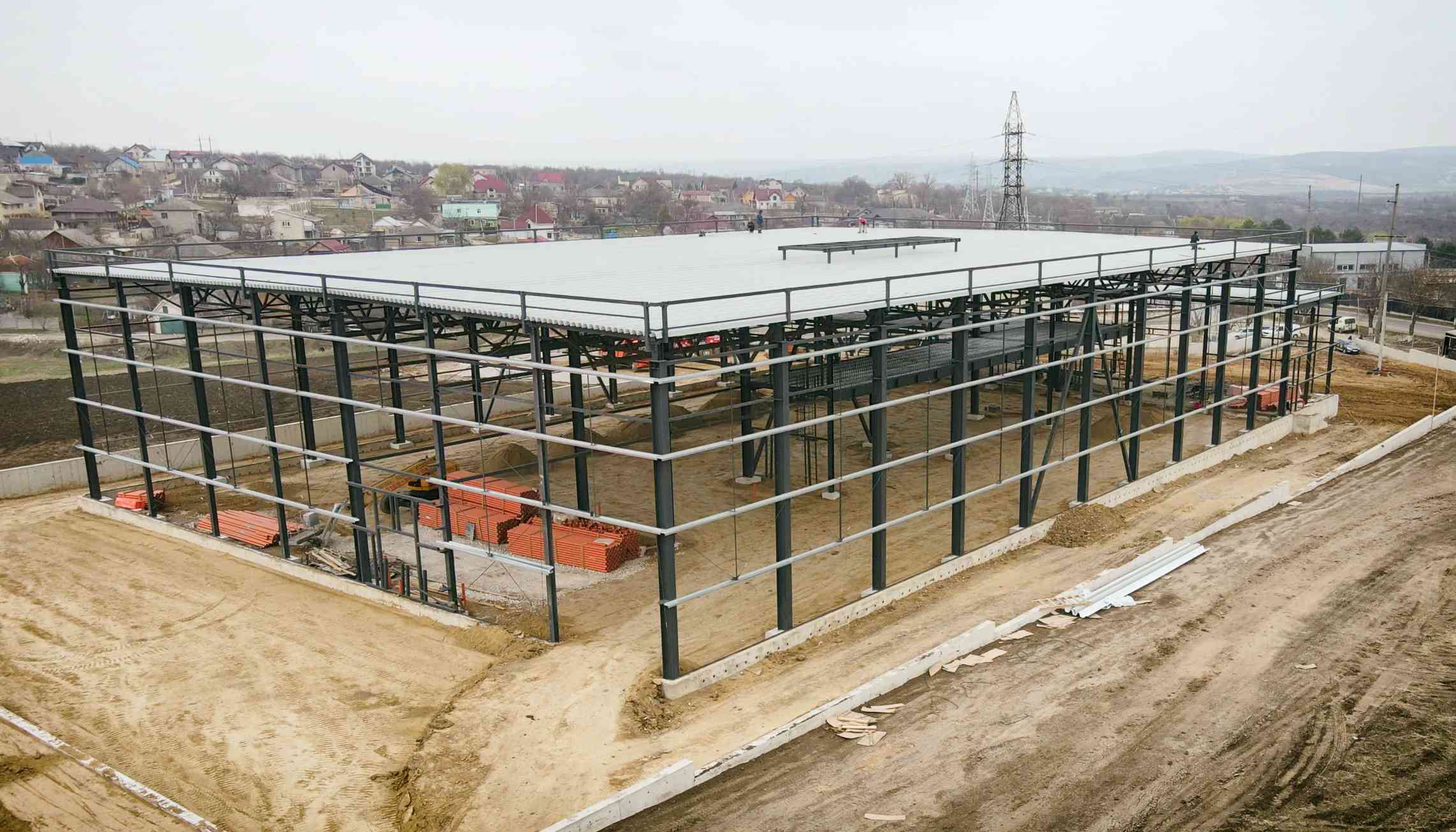
What is a sandwich panel
A sandwich panel is a cladding element made of two steel sheets, usually galvanized and pre-painted, with an insulating core between them. The result is a lightweight, rigid, quick-to-install panel that provides enclosure, insulation and finish all at once. For industrial buildings, warehouses and commercial spaces, sandwich panels have become the standard solution for walls and roofs.
The key difference between types is the core. The most widely used are polyisocyanurate foam (PIR), basalt mineral wool and expanded polystyrene (EPS).
PIR core panels
PIR foam has one of the best thermal performances among common materials, with a conductivity of approximately 0.022–0.024 W/mK. This means that for the same thermal resistance, the panel can be thinner than a mineral wool one.
- Advantages: very good insulation, low weight, negligible water absorption, durability.
- Limitations: lower fire performance than mineral wool, although PIR is significantly better than conventional polyurethane foams; higher price than EPS.
- Typical use: cold storage facilities and freezer rooms, heated buildings, buildings where energy efficiency is a priority.
Mineral wool panels
The basalt mineral wool core, with fibers oriented perpendicular to the sheets, is non-combustible. Its thermal conductivity is approximately 0.038–0.045 W/mK, so for the same thermal performance the panel has to be thicker.
- Advantages: high fire resistance, including the ability to build firewalls, good sound insulation.
- Limitations: greater weight, sensitivity to moisture if joint sealing is neglected.
- Typical use: fire-rated partition walls, production buildings with a fire risk, buildings where regulations require non-combustible materials, spaces with acoustic requirements.
EPS core panels
Expanded polystyrene is the most economical option. Its thermal insulation is acceptable, with a conductivity of around 0.036–0.040 W/mK, and its weight is minimal.
- Advantages: low price, easy installation.
- Limitations: poor fire performance, lower mechanical strength, use restricted by fire safety regulations in many building types.
- Typical use: auxiliary structures, annexes, spaces without high fire requirements.
Selection criteria
Thermal regime
For an unheated warehouse, a 50–80 mm panel is often sufficient. Heated buildings frequently use thicknesses of 100–150 mm, while cold rooms and freezer rooms use 120–200 mm or more, depending on the indoor temperature.
Fire safety
The required reaction-to-fire class and fire resistance follow from the building’s fire safety strategy. The types are often combined: mineral wool on firewalls and PIR elsewhere.
Indoor environment
In livestock farms or the food industry, the type of sheet coating matters: paints with enhanced chemical resistance or food-safe finishes.
Installation details
A good panel installed poorly loses much of its performance. Thermal bridges at joints, sealing with tapes and gaskets, screws with EPDM washers and edge flashings are just as important as the core.
Do not compare panels only by price per square meter. Compare the actual thermal resistance, fire class, coating warranty and energy cost over the entire service life.
Sheet coating and durability
The appearance and service life of a panel depend heavily on the coating of the steel sheet. Standard polyester is suitable for most moderate conditions, while thicker coatings such as PVDF or plastisol are chosen for aggressive environments or high humidity. Also pay attention to the thickness of the sheet and of the zinc layer: savings on these parameters show up after a few years.
Conclusion
There is no “best” panel in general, only the right panel for each area of the building. When designing industrial buildings and cold storage facilities, S.A. COLASS engineers choose the type and thickness of the panels based on the thermal regime, fire requirements and the client’s budget.
Need a recommendation for your project? Contact us at +373 78 30 40 40 for a tailored solution and quote.