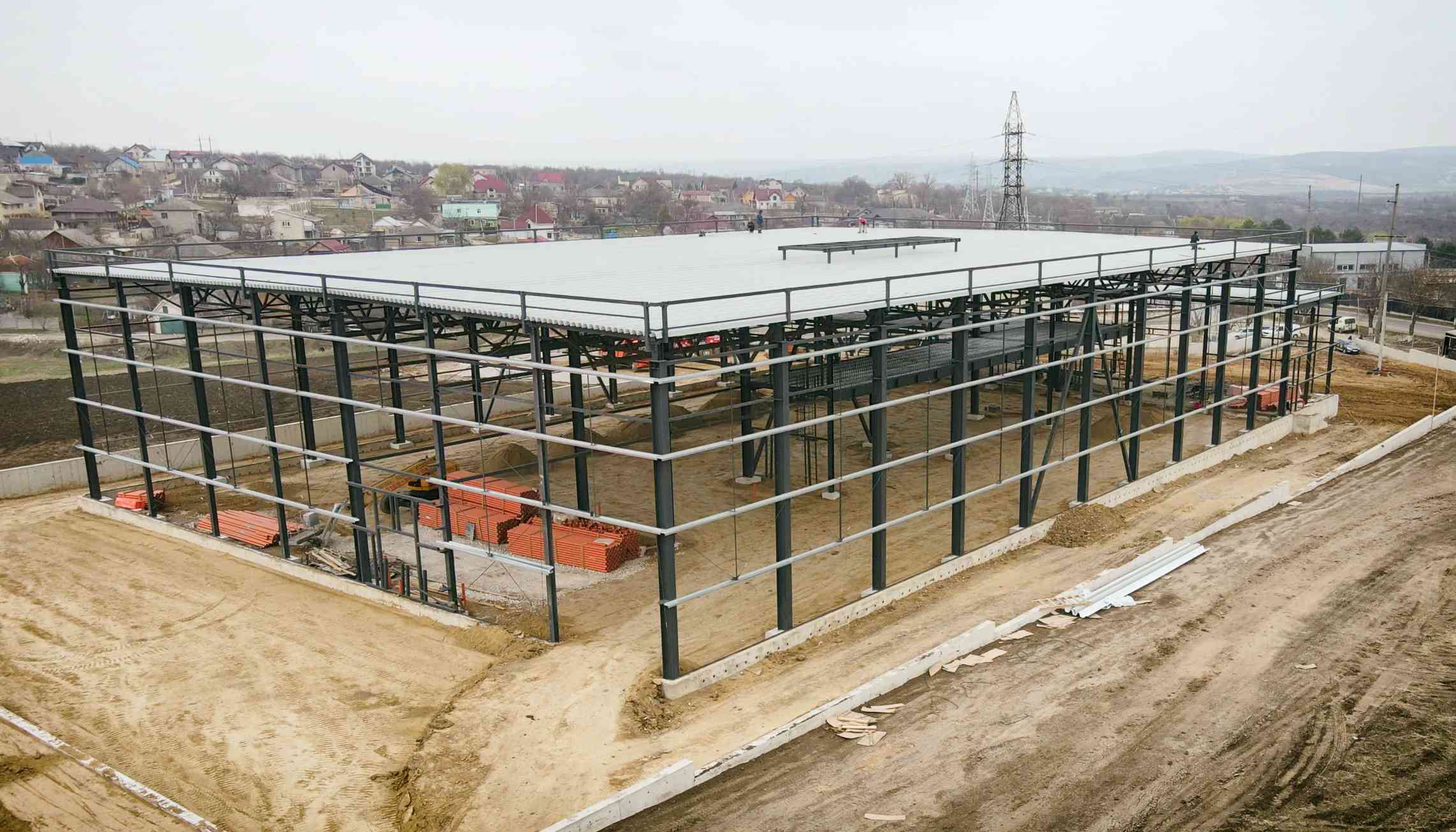
In Moldova, winters can bring periods of below-freezing temperatures, snow, and wind, alternating with relatively mild days. Many investors assume the job site must be shut down from November through March. In reality, with proper planning, much of the work can continue, and the time gained can be decisive for putting the facility into operation in the spring.
What Work Is Best Suited to Winter
- Fabrication of steel structures in the plant – completely independent of the weather. Winter is the ideal time to prepare the elements that will be erected in the spring.
- Erection of structural steel – possible at below-freezing temperatures, with specific measures.
- Installation of roofing and wall panels – on days without strong wind or precipitation.
- Interior work in an already enclosed building – building systems, partitions, finishes, with temporary heating.
- Design and obtaining approvals – winter is the optimal time for preparing documentation.
More difficult are earthworks in frozen ground and “wet” work – concrete placement, plastering, screeds – which require special measures.
Concreting in Cold Weather
Concrete gains strength through cement hydration, a chemical process that slows down sharply at low temperatures and practically stops when the water in the concrete freezes. If fresh concrete freezes before reaching a minimum strength, its internal structure can be irreversibly damaged.
The basic rule: concrete must be protected from freezing until it reaches the critical strength specified by the standards and the design. The exact values and methods are determined by the concrete technologist for each case.
Measures When Mixing and Placing Concrete
- using adapted mix designs: faster-setting cement, accelerating or antifreeze admixtures, according to the manufacturer’s recommendations;
- delivering concrete at the proper temperature, with the shortest possible haul;
- clearing snow and ice from formwork and rebar before placement;
- prohibiting placement on frozen ground – the subgrade is protected or heated beforehand;
- organizing the pour without long interruptions.
Protection After Placement
- immediate covering with plastic sheeting and insulating blankets;
- insulated or heated formwork for thin elements;
- temporary enclosures with hot-air heaters for larger volumes;
- electric heating of the concrete, where technically justified;
- monitoring the concrete temperature with sensors or thermometers and recording it in a log.
Formwork is stripped only after the strength has been confirmed, and cooling must be gradual to avoid cracking from thermal shock.
Erecting Steel Structures in Winter
Steel is not “afraid” of the cold the way concrete is, but winter erection has its own particularities:
- ice and snow are removed from the elements before lifting – they add weight and make surfaces slippery;
- welding at low temperatures may require preheating the parts and keeping electrodes dry, in accordance with the welding procedure;
- bolted connections are tightened to the specified torque, checking the condition of the contact surfaces;
- anticorrosion painting and touch-ups have minimum temperature and humidity limits specified by the paint manufacturer;
- short days call for additional lighting of the work area.
Safety becomes even more important: slippery surfaces, cold wind, and bulky clothing reduce mobility. Access routes are cleared and treated against ice, and warm-up breaks are planned.
Equipment in Winter
Winter diesel, checked batteries, engine preheaters, and appropriate tires are mandatory. Cranes have operating temperature limits specified by the manufacturer, which must be observed.
Economic Planning
Working in winter involves some additional costs – heating, protection, admixtures, somewhat lower productivity. In return, entire months are gained: a building erected and enclosed during the winter can be completed and put into operation in early spring. For many investors, this time gain more than offsets the costs.
Colass uses the cold months to fabricate structures in its own plant and continues erection on site whenever conditions allow it to be done safely.
Want to start your project without waiting for spring? Call +373 78 30 40 40 to plan the winter work together.